Showing posts with label Madagascar. Show all posts

Saturday, April 7, 2012

Intelligence Testing

My family of geniuses trying to figure out the best way to erect a 20 foot Christmas tree of only lights.... I stayed away and let my husband join the fun!


The combination of genetics and environment has worked well for my family.  I grew up in a family of three where my father has a PhD (bio-physics at that!), my sister and I tested into gifted programs in elementary school, and my brother is brilliant.  My own children are doing amazingly well in school and continue to be at the top of their classes (in 1st and 3rd grade). This is why I went into education.  In particular my brother…  As I said he is brilliant!  He also has a learning disability and in elementary school they would not do an IQ test because he was testing at needing to be in a resource room for reading.  He has struggled through school and does not like to be an advocate for himself.  I remember him understanding the concepts of algebra in preschool, yet reading and writing were difficult for him.  In High School he went to the School for Science and Math in North Carolina which is a residential school for juniors and seniors around the state to “where students study a specialized curriculum emphasizing science and mathematics.” 
I went into school with a focus on special education, thinking that it would include a focus on the low and high ends of the bell curve.  In fact, there is little known about those with a high IQ compared to the wealth of knowledge we have on those on the opposite end.  There are many commonalities between the two and what we have learned about education for one subgroup can easily be applied to any other subgroup (middle, high, low etc). 
The purpose of an IQ test is to determine a person’s mental abilities relative to others of the same age.  If you score below 100 you are mentally at a younger age than the average, same goes if you are above the average.  I was reading an article on this topic and realized that if we take the children who fall in the center portion of the bell curve, this includes all children from an IQ of 70 to 130.  All of these children are typically placed in the same classroom in the United States.  At 3 years old, their mean age has a disparity of 1.8 years.  By 6 years old the disparity is 3.6 years and at 12 the disparity has grown to 7.2 years.  What does this mean for educators?  I’ll let you come up with your own conclusions.    
We may not have a schooling system in the United States that meets our highest achieving students and helps them completely in the ways they need, but we do have a system that is beginning to see their needs and provide supports.  This is opposed to so many in the world, who are unable to attend school, let alone have an intelligence test done or receive supports on the low or high end of the bell curve.
I decided to keep my focus on Madagascar again and see what their education system is like.  They do have mandatory education for children 6 to 14.  Nevertheless, like I wrote before, child labor is rampant in the country and many children are not offered the opportunity for an education due to their work.  In 2000, 14% of the children continued their education and enrolled in secondary school (age 12 to 17).  The UNESCO has been working with Madagascar for the “Education for All” up until 2009.   The political unrest in Madagascar has limited the ability to help education all the children and poorer and rural areas definitely suffer more.
As an early childhood educator at heart, I have been trained to teach to each individual child’s strengths and weaknesses.  If all educators were to take that stance, we would be grouping children by strengths and weaknesses, not by their IQ or label.  Determining IQ and labels should only be used when more information about the child is needed, but even that does not always give needed information.  When we focus on strengths and weaknesses, we look at each individual child and developing an education plan for that child.  I know that there are a lot of politics and financial issues there, but that in my opinion is what is needed in the United States and around the world. 

Saturday, March 24, 2012

Malagasy Children and Child Labor


I have been blessed to not have endured stressors during my childhood.  I asked my parents if they had and my dad shared a story with me I had never heard.  He was never allowed to ride a horse because my grandmother had been thrown off a horse and then stepped on by the horse.  As a result, my grandfather had to do the heavy lifting with the laundry because she had hurt her back.  While not a real huge stressor in childhood, it is a true example of how one incident can affect so much of your life.  In the 20’s and 30’s it was not common for the husband to help with the laundry.

I decided to look at Madagascar again, as that is where our friends are serving.  Check out their amazing journey here.  Some of the great stressors on childhood in Madagascar are: violence against children, forced marriages for girls, forced child labor, lack of care, environmental issues, and discrimination.

Through my reading I found the term “Worst Forms of Child Labor” which includes slavery (sales, trafficking, serfdom, forced labor, using children in armed conflict), Sexual exploitation of children (prostitution & pornography), and using children for illegal activities.

The question is posed “Why is it urgent and important to take action against the worst forms of child labor?  Their answers include:
  •  It is a matter of human rights
  • It is a matter of saving lives.
  • It is a matter of combating some particularly odious forms of organized crime.
  • It is a matter of protecting children from the horrors of war. 
  • It is a matter of building a nation’s future.
  • It is a matter of international concern.
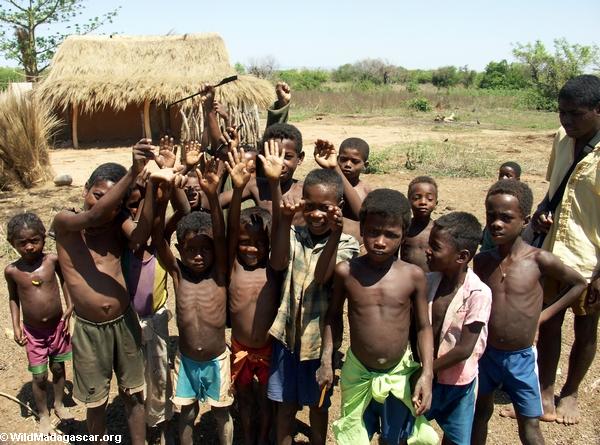
Photos of beautiful Malagasy children
In Madagascar the child labor imposed on nearly 1.9 million children involves sexual exploitation of children, work in stone quarries and mines, domestic servitude, farm and fishing industry work, and other work in dangerous and unhealthy urban and rural jobs.  This represents 20% of 5-9 year olds and 50% of 10-14 year old children are exposed to these labor conditions.

Madagascar has ratified the Convention on the Rights of the Child, and are in the very beginning stages of enacting government procedures to protect children.  January 20, 2012 the United Nations considered the Madagascar report and their dialogue is posted here.

Along with the governmental work, Pact, a non-profit is working in Madagascar to use education to combat child labor.

Saturday, March 10, 2012

Access to Healthy Water


Two summers ago, our Vacation Bible School decided to choose this issue to talk with the kids about and raise funds.  Through the one week, we raised over $600, which went to Lutheran World Relief to help build wells for communities. 
Water is one of the necessities for life. (I’m singing “The Bare Necessities” in my headJ).  Many in the western world take the abundance of clean water for granted, my family included.  We turn on the faucet and there is water to drink, clean with, cook with, or do whatever we want with.  We can even choose if we want the water hot or cold. 
I decided to look at some websites and see if they had published materials on the topic (I was sure they had …and they did.)  The World Health Organization (WHO) has published “Guidelines for drinking-water quality.”  As described by the United Nations (UN) this is a set of “international norms on water quality and human health in the form of guidelines that are used as the basis for regulation and standard setting, in developing and developed countries worldwide.”
I decided to look up information on Madagascar.  We have some friends who have recently begun a 4 year stay there and so thought this would be a great place to see how their water rates.  WHO has an office in Madagascar and some information including in a  Health Profile, which compares their numbers to the WHO African Region.  As of 2002 75% of the urban population had access to an improved water source and only 34% in rural areas.  These are lower percentages than the WHO African Region, which means there is still work to do.   One of the WHO’s millennium goals in Madagascar is to improve access to an improved water source, although I was not able to find information on how they are going about this work.  A correction.  The materials may be there, but they aren’t in English, so I don’t know if they exist or not.
The UN is currently near the end of their decade focus on water.  The Water for Life section has a site specifically dedicated for educating kids about different water issues.  I think I will be getting my kids linked in here … and start some conversations in our home as to how we can do our part.